Skip to content

Professional

Six years of teaching, curriculum and assessment.

A record of where I've taught, what I've built, and the questions I've researched along the way.
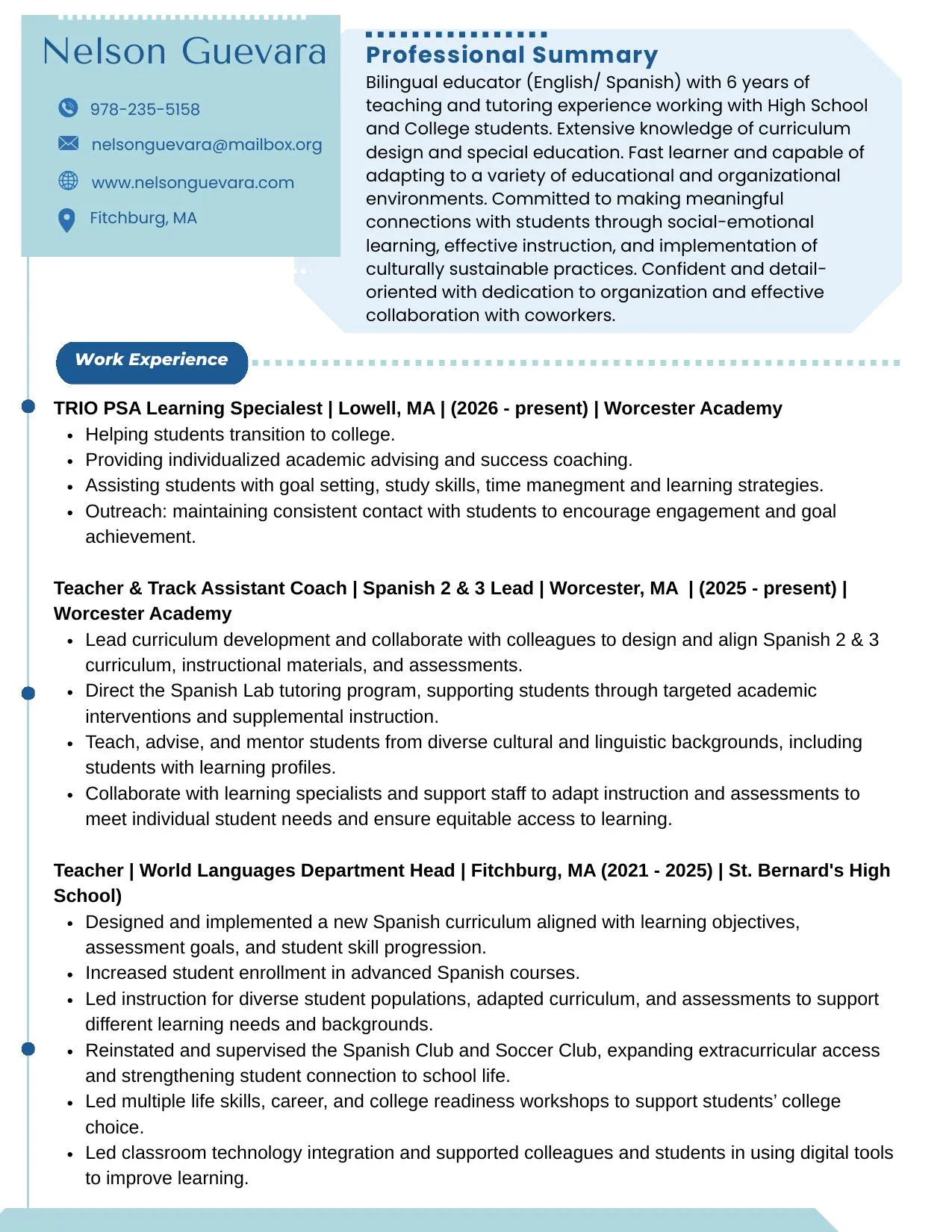
First page of Nelson Guevara's résumé

Résumé

The short version

Bilingual educator (English/Spanish) with six years of teaching and tutoring experience across high school and college settings. Extensive knowledge of curriculum design and special education, committed to making meaningful connections with students through social-emotional learning and culturally sustainable practices.

Career timeline

Where I've worked

From a warehouse floor to a world languages department head — every role taught me something about how people learn. Open any role to see what it involved.

  1. 2026 — Present

    • Help students transition to college.
    • Provide individualized academic advising and success coaching.
    • Assist students with goal setting, study skills, time management and learning strategies.
    • Outreach: maintain consistent contact with students to encourage engagement and goal achievement.
  2. 2025 — Present

    • Lead curriculum development and collaborate with colleagues to design and align Spanish 2 & 3 curriculum, instructional materials, and assessments.
    • Direct the Spanish Lab tutoring program, supporting students through targeted academic interventions and supplemental instruction.
    • Teach, advise, and mentor students from diverse cultural and linguistic backgrounds, including students with learning profiles.
    • Collaborate with learning specialists and support staff to adapt instruction and assessments to meet individual student needs and ensure equitable access to learning.
  3. 2021 — 2025

    • Designed and implemented a new Spanish curriculum aligned with learning objectives, assessment goals, and student skill progression.
    • Increased student enrollment in advanced Spanish courses.
    • Led instruction for diverse student populations, adapting curriculum and assessments to support different learning needs and backgrounds.
    • Reinstated and supervised the Spanish Club and Soccer Club, expanding extracurricular access and strengthening student connection to school life.
    • Led multiple life skills, career, and college readiness workshops to support students’ college choice.
    • Led classroom technology integration and supported colleagues and students in using digital tools to improve learning.
  4. 2021 — 2022

    • Evaluated and scored student writing assessments using standardized rubrics to ensure alignment with program expectations.
    • Evaluated the effectiveness of standardized rubrics and provided feedback for improvement.
  5. 2019 — 2021

    • Delivered SAT verbal instruction through structured weekly lessons focused on reading comprehension, writing, and test-taking strategies.
    • Designed lesson plans and instructional materials aligned with assessment goals and student skill development.
    • Supported students from underrepresented backgrounds in learning about college readiness.
  6. 2015 — 2018

    • Provided one-on-one and small-group academic support for college students, including ENG 101 writing and foundational literacy skills.
    • Designed and facilitated after-school academic support sessions to reinforce course concepts and improve student persistence.
    • Supported diverse learners, including first-generation and multilingual students, through individualized tutoring and academic coaching.
    • Assisted faculty by reinforcing learning goals and helping students develop effective study strategies.
  7. 2013 — 2018

    • Supervised and trained a team of approximately 80 associates in a fast-paced warehouse environment, supporting onboarding, performance, and quality standards.
    • Developed and implemented standard operating procedures (SOPs) to improve consistency, efficiency, and safety.
    • Monitored operational metrics and inventory control data to identify process improvements and accomplish production goals.
    • Fostered a positive, inclusive work environment across diverse cultural and linguistic backgrounds.
    • Collaborated with the higher management team and sales team to communicate plans and procedures to associates.
  8. 2012 — 2013

    • Taught music theory and guitar to students in an international educational setting.
    • Designed lesson plans that emphasized the classroom environment and music pedagogy strategies.

Education

Degrees and honours

2023 — 2025

Master of Education

Curriculum and Instruction

UMass Lowell

GPA 3.97

2018 — 2021

Bachelor of Arts

English & Philosophy

Clark University

  • Summa Cum Laude
  • Second Prize of Philosophy
  • Sigma Tau Delta

GPA 3.84

2015 — 2018

Associate of Arts & Sciences

English, Literature Concentration

Middlesex Community College

  • Outstanding Student Award
  • Phi Theta Kappa
  • CRLA Tutor Level 1

GPA 3.67

Research & writing

Papers and capstones

Longer arguments about motivation, assessment, and the philosophy of knowledge.
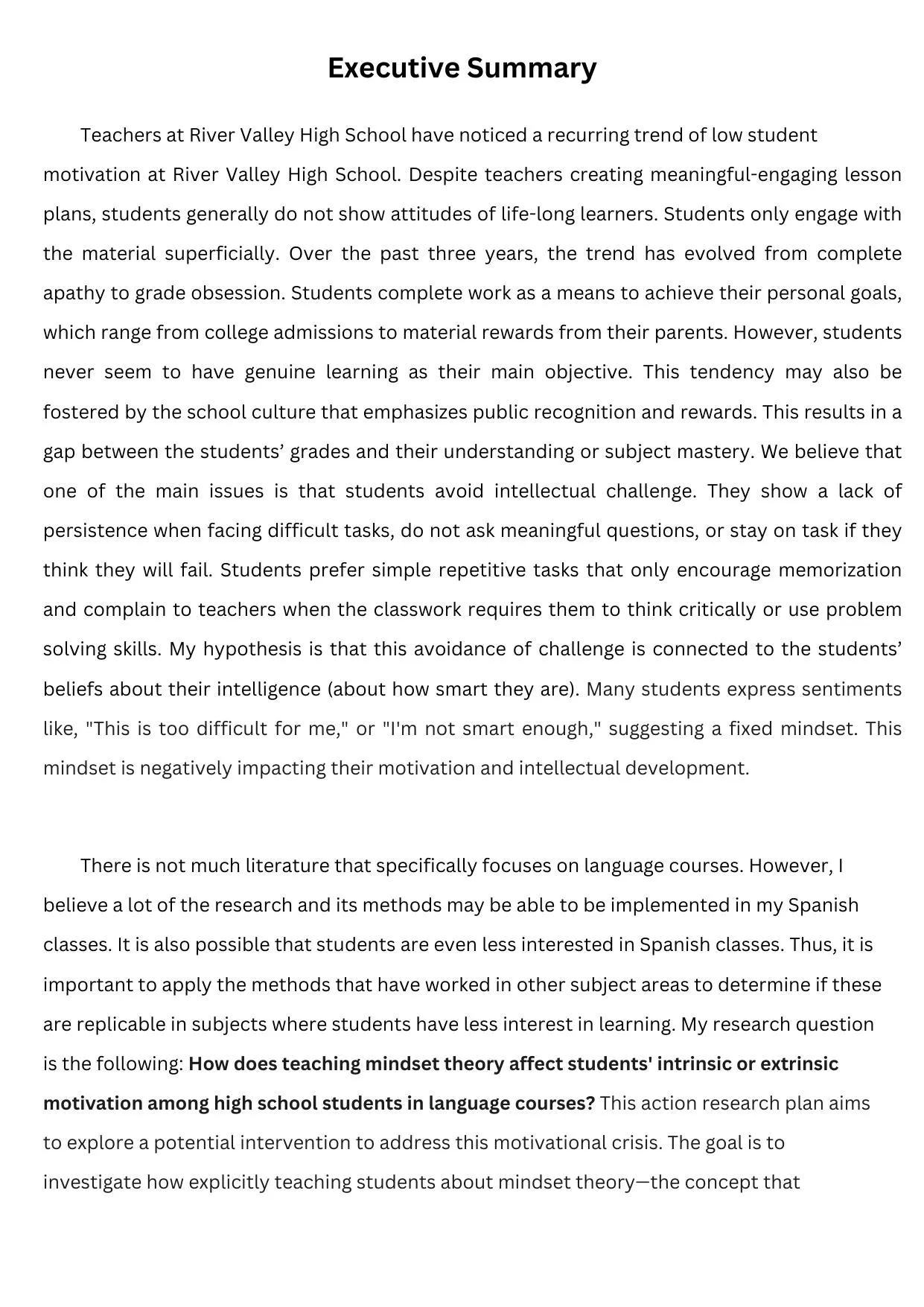
First page of From Grade Obsession to Growth Mindset

Action Research Plan

From Grade Obsession to Growth Mindset

Throughout all of my teaching experiences, I’ve noticed a trend that I’m sure most teachers are aware of — students are not motivated to learn. This action research plan aims to explore a potential intervention to address this motivational crisis.

The goal is to investigate how explicitly teaching students about mindset theory — the concept that intelligence is malleable and can be developed through effort — impacts their motivation, classroom behaviors, and academic performance.
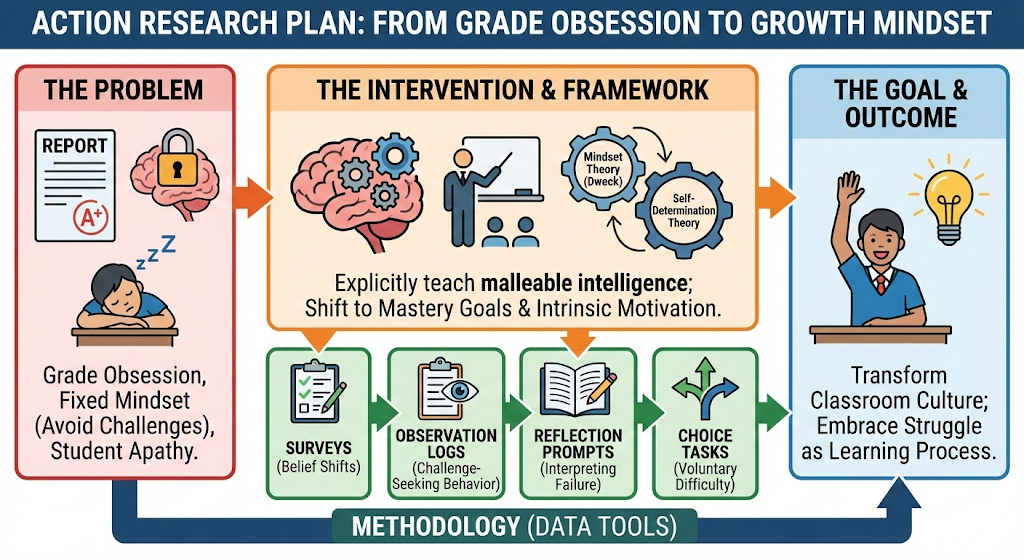
Action research plan: the problem (grade obsession, fixed mindset, student apathy) leads to an intervention teaching malleable intelligence, measured through surveys, observation logs, reflection prompts and choice tasks, aiming at a classroom culture that embraces struggle as learning.
Diagram — open in a new tab for full size.
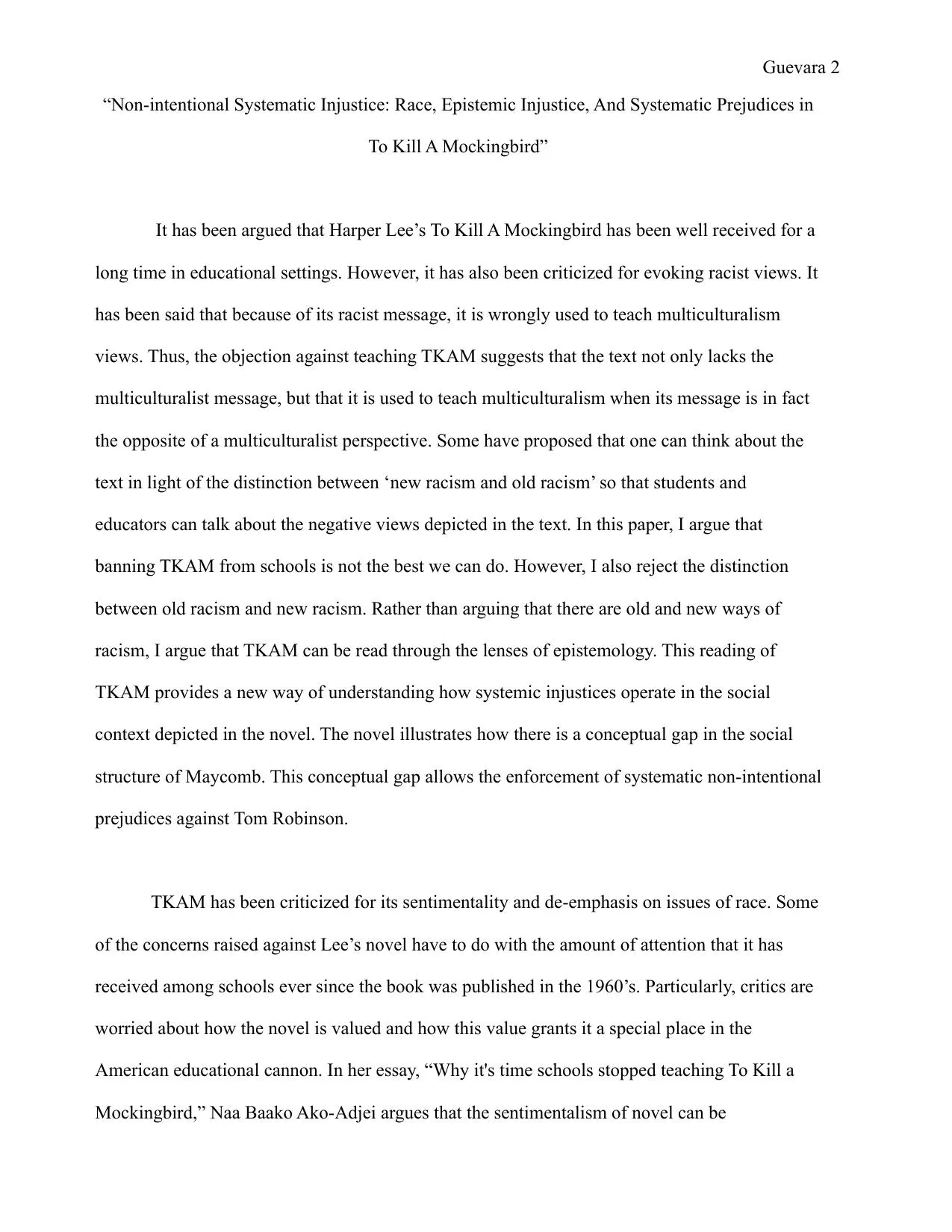
First page of Racism, Epistemic Injustice, and the Conceptual Gap

English Capstone

Racism, Epistemic Injustice, and the Conceptual Gap

In this paper, I argue against banning To Kill A Mockingbird from schools, proposing instead that educators use the text to deconstruct how systematic prejudices operate through a lack of shared knowledge.

Beyond old vs. new racism. I argue that the “old vs. new racism” binary is an inadequate framework that fails to capture how systematic injustices function independently of individual intent.

Borrowing from Miranda Fricker’s philosophy, I argue that the novel depicts non-intentional systematic injustice, where a conceptual gap in Maycomb’s collective understanding prevents characters from recognizing their own enforcement of prejudice. However, non-intentional is not the same as unintentional: “unintentional” implies a lack of intention that might diminish agency, whereas non-intentional racism suggests that there is an agent who is responsible.

The conceptual gap. The characters perpetuate racism not necessarily through malice alone, but because they lack the hermeneutical resources — the specific concept of racism — to define and challenge their reality.
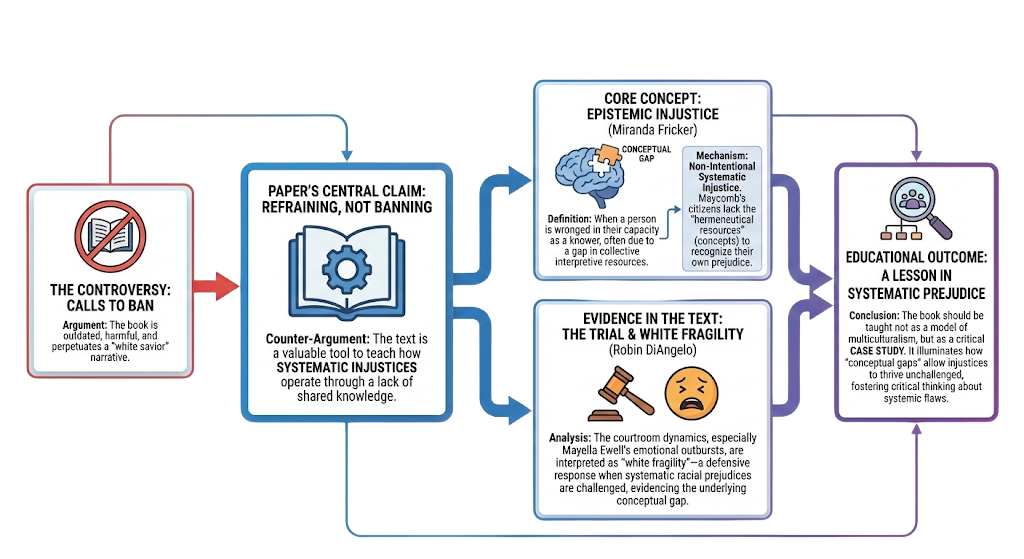
Argument map: calls to ban To Kill A Mockingbird, countered by the claim that the text should be reframed not banned, drawing on Miranda Fricker's epistemic injustice and the conceptual gap, evidenced by Mayella Ewell and white fragility, concluding with an educational outcome.
Diagram — open in a new tab for full size.
First page of The Purpose of Knowledge Beyond the Good Informant

Philosophy Capstone · Undergraduate

The Purpose of Knowledge Beyond the Good Informant

In this paper, I challenge Edward Craig’s practical explication of knowledge, arguing that the true purpose of knowledge is not merely to identify “good informants” or conduct inquiry, but to dictate purpose and meaning through human cognitive capacities.

The To Kill A Mockingbird counter-example. To illustrate the failure of Craig’s theory, I use the trial of Tom Robinson as a thought experiment. Under Craig’s theory, both Tom Robinson and Mayella Ewell could be seen as good informants telling their version of the truth based on their methods. Craig’s framework cannot account for testimonial injustice, where prejudice causes a credibility deficit despite the speaker possessing knowledge.

Rejection of inquiry as purpose. I also examine Klemens Kappel’s view that the purpose of knowledge is enquiry. I argue that inquiry cannot be the fundamental purpose because inquiry itself presupposes the existence of knowledge; one cannot inquire without starting from existing beliefs or cognitive capacities.
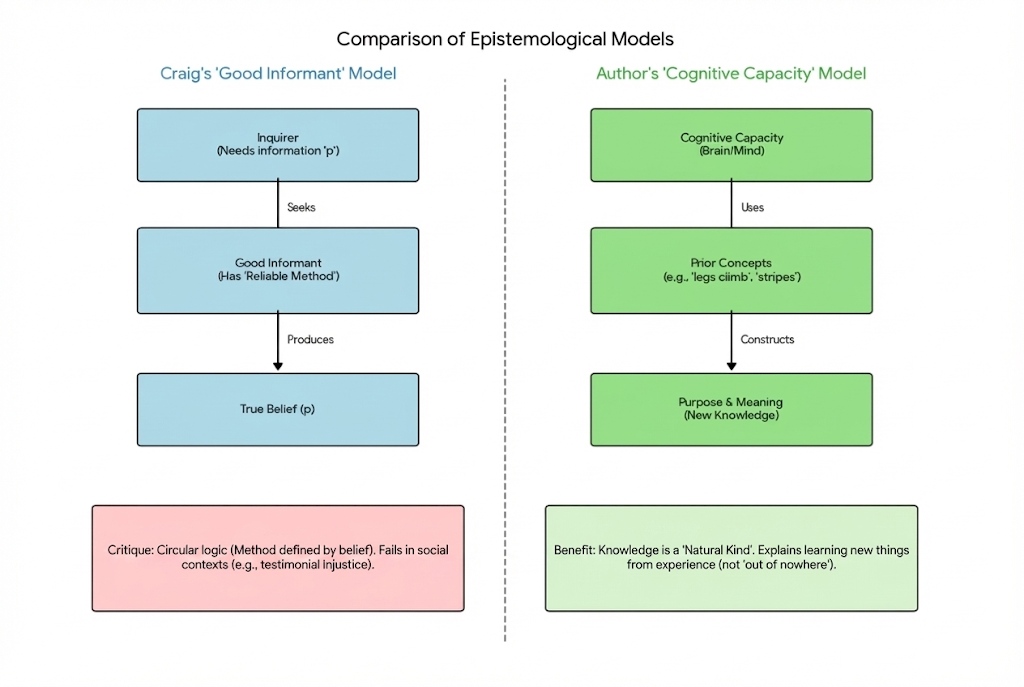
Side-by-side comparison of Craig's good informant model, critiqued as circular logic that fails in social contexts, against the author's cognitive capacity model, in which knowledge is a natural kind.
Diagram — open in a new tab for full size.

Document

100%

Opening…

Drag a page corner or use ← → to turn pages · + and − resize · Esc to close